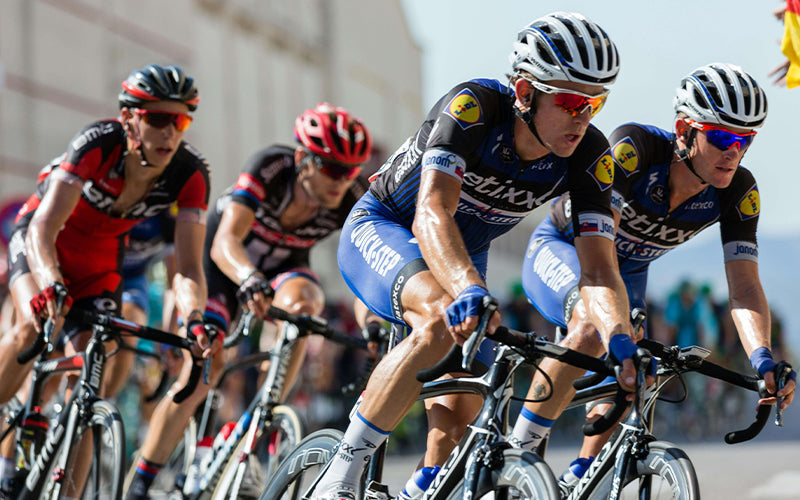
For cycling beginners, the Tour de France can initially seem overwhelming. That's why we've put together this compact guide to help you get started with this prestigious race.
The Tour takes place every July (2025 from July 5th to 27th) and covers over 3000 kilometers. 23 teams, each with 8 riders, compete. The 21 stages lead through flat, hilly, and mountainous terrain. The finish line is on the Champs-Élysées in Paris.
The "Grand Départ", the ceremonial start, begins in Lille in 2025. There are usually 1–3 individual time trials, which are often decisive for the race.

🟨 Yellow Jersey – General Classification Leader
The yellow jersey is worn by the rider with the lowest overall time. Each team has a captain, who is supported by domestiques through drafting, provisions, and even bike changes.

Only riders with strong climbing and time trial performances have a chance for the yellow jersey. Mark Cavendish, for example, won 34 stages but could never compete for the general classification.
🟩 Green Jersey – Best Sprinter (Points Classification)
This jersey goes to the rider with the most points from intermediate sprints and stage finishes. Flat stages offer the most points, ideal for sprinters and their "sprint trains."

🔴 Polka Dot Jersey – Best Climber
The "King of the Mountains" collects points on climbs, which are divided into five difficulty levels (from 4 to HC). The harder the climb, the more points.

⚪ White Jersey – Best Young Rider
For riders under 25 with the best overall time – the rules are identical to the yellow jersey.
🔴 Red Bib Number – Most Aggressive Rider
Each stage awards the most active rider – usually someone who was on a solo breakaway for a particularly long time. The next day, they wear a red bib number.
🤝 Unwritten Rules
In addition to official rules, there are unwritten laws. For example: Respect for the Yellow Jersey – if the leader crashes early in the race, the peloton waits.
Even in dangerous weather, the peloton can slow down – as happened in 2020 during rain chaos on the opening stage.
On the last day in Paris, there's a gentleman's agreement: no attacks on the general classification. Instead, riders celebrate with champagne before the final sprint on the Champs-Élysées begins.